

Kenya Doesn’t Have a Youth in Agriculture Problem. It Has an Enterprise Development Problem
Every year, new programmes launch to bring young people into farming. They recruit thousands. They train, mentor, equip and celebrate. Graduation photos fill social media.
Then ask a harder question. Where are the thriving firms those programmes produced five years ago? Ten years ago? The sector has trained hundreds of thousands of young people. It should be able to point to thousands of growing firms. It struggles to point to hundreds.
The usual answer blames the young people. They lack drive. They want quick money. They have the wrong mindset. So the next programme adds more mindset training, and the cycle repeats.
The answer is more uncomfortable. Young people are not the problem. Nor is their interest in farming. The problem is that many programmes are designed to create participants, not firms that can compete.
A business survives because customers keep buying. Not because a project keeps supporting it.
Most youth agriculture programmes are built around the second logic while reporting on the first. That is a design flaw, and it repeats across five failures.
- Why do youth-led agribusinesses fade when projects close?
- Recruiting youth before we identifying markets
- Training entrepreneurs instead of building enterprises
- Dependency
- Program Outputs and Impact Measurement
- We build lone entrepreneurs instead of ecosystems
- How to design better Youth empowerment projects
- The Point
Why do youth-led agribusinesses fade when projects close?
To be clear from the start, this is not an argument against youth programmes. Many have been transformative. Young people have gained real skills, real assets and real confidence from them. Some have built firms that last.
The argument here is about scale and survival. Programmes struggle to produce agribusinesses that keep trading and growing after project support ends. The odds were always going to be hard. Kenya’s 2016 MSME Survey found that 2.2 million small businesses closed in just five years, and nearly half of new ones close within their first year. Any programme sending young people into that arena should be designed around survival from day one.
Most are not. The gap is not random. It follows directly from five design failures, and each failure has a fix that mirrors it.
Recruiting youth before we identifying markets
Beneficiaries first, demand later
Watch how most youth farming programmes are set up. A huge target is set. Five hundred young people. Two thousand young people. Recruitment starts. Training venues get booked. Only later does anyone ask what these new farmers will sell, and to whom.
That is backwards. No serious firm starts with staff and then goes looking for customers. It starts with demand.
Start with the market gap
The better starting point is a market question. Supermarkets in the region need two million more eggs a week. A processor cannot source enough sorghum. An exporter is turning away orders for lack of certified avocado supply.
Now the programme has a reason to exist. Recruit young people into that confirmed gap. Size the intake to the demand, not to a donor target. Train for the exact quality and volume the buyer wants.
Market first. Youth second. Businesses exist because markets exist. Training cannot create demand that is not already there.
Reverse the order and the maths turns cruel. Five hundred trained poultry keepers sell into a market that needed two hundred. Prices collapse for all of them.
Kenya has lived this story many times. A crop becomes the fashion. Programmes and counties push it hard. Thousands plant. The glut arrives, the price crashes, and the young farmers who trusted the advice carry the loss. The programme reports its training numbers and moves on. Demand was never checked. The youth paid for that.
Two logics, two outcomes
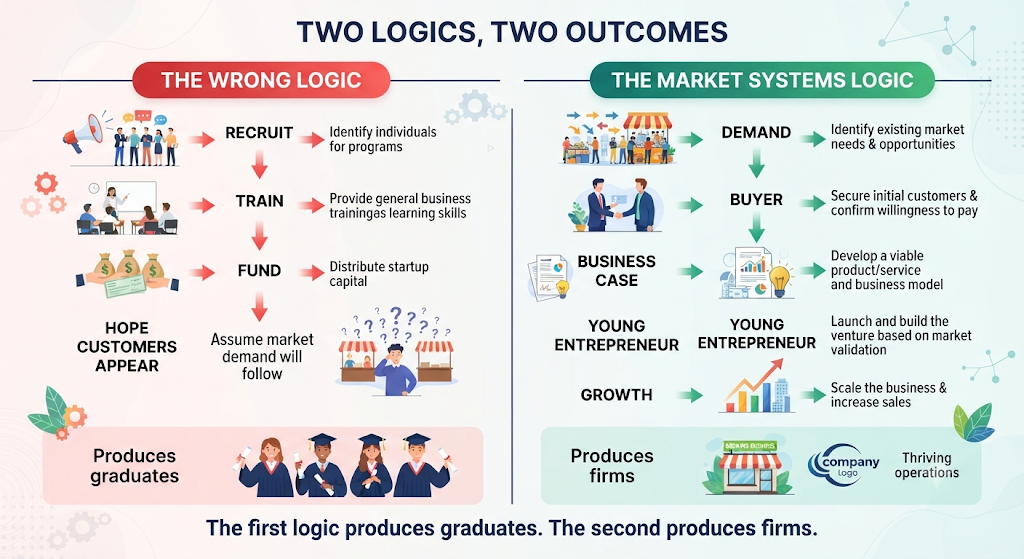
The first logic produces graduates. The second produces firms.
Training entrepreneurs instead of building enterprises
What training can and cannot do
NGO BDS projects deliver business plans, entrepreneurship modules, financial literacy, leadership and mindset sessions. This has value. A young person who can read a margin is better off than one who cannot.
But look at why young agribusinesses actually die. No customers. Thin margins. Broken supply chains. No working capital. Stronger competitors. Not one of these is cured in a training room. No firm has ever died because the owner forgot how to do a SWOT analysis.
Markets create entrepreneurs
Training assumes the constraint is are the young people. Usually the root cause is the market. A brilliant graduate with no buyer has a certificate. An average one with a supply contract has a business.
Ask the young people themselves and they will tell you. In session after session, their first request is not more training. It is a market. Where do I sell? At what price? Who pays on time? Programmes that cannot answer those three questions are not ready to recruit anyone.
Entrepreneurs do not build markets. Markets create entrepreneurs. Kenya’s most successful young agripreneurs rarely credit a workshop for their success. They credit a customer who kept ordering, which forced them to learn everything else.
The fix is a change of effort. Spend as much time securing buyers and supply deals as is spent on classroom content. Train against a real contract and the training compounds. Train into a vacuum and it evaporates.
Dependency
Dependency wears many disguises
This may be the worst failure, because it hides itself as kindness. The question is not whether programmes should help. It is how. And subsidy is only the most visible face of help gone wrong.
Free incubation. Free equipment. Free inputs. Free transport to trade fairs. Free branding, free stalls, free airtime. Ask who does all this, and who pays for it, and the answer is always the programme. For two or three years, the young business floats on subsidy. It looks impressive in every field visit.
Every one of those services should sit on a cost-sharing model instead. A founder who pays a share of her incubation, inputs and stall is signalling commitment. Free attracts everyone, including those who came for the allowance. A price attracts struggling startups that value the support and plan to outlast the project.
But money is not the only dependency. The programme finds the customers. It manages the bookkeeping. It transports the produce. It pays allowances for attendance. It organises and funds the trade fairs. Each service creates the same dependency a cash subsidy does, just harder to see.
Look closely at that list. The programme has become the biggest customer, the operations manager and the banker of every business it supports. The young owners are not serving a market. They are serving the programme, and being paid to do so.
The quiet collapse at exit
Then the project closes. It does not merely withdraw support. It withdraws demand. The businesses do not lose a helper. They lose their main client. Of course they close. Nothing failed at the end. The failure was built in at the start, because the business model was never tested against real prices and real customers.
Nobody planned this. Each act of help made sense on its own. Paying allowances raised attendance. Buying the stock saved time. Finding the customer hit the quarter’s target. But added together, the help replaced the market. The kindest programme became the biggest risk in every business it touched.
The survival test
Market systems practice has a rule for the alternative. Facilitate, never become the market. Every task a programme does itself is a task the market never learns to do. So ask, for every planned activity, who should be doing this three years from now. Then start handing it to that actor today, not in the final quarter. The objective is not to withdraw support quickly. It is to transfer responsibility deliberately.
And keep applying one test. Could this business survive if everything the programme provides disappeared tomorrow? If the answer is no, the programme is not building a firm. It is renting one.
There is a simple way to spot the difference in the field. Ask the young owner what one crate costs to produce and deliver. An owner running a real business answers in seconds. An owner running a project business looks for the file.
Program Outputs and Impact Measurement
Counting the wrong things
Open a typical youth programme report. Youth trained. Youth reached. Businesses registered. Grants disbursed. Trade fairs attended. All counted precisely, all achieved, all celebrated.
These are outputs. They measure programme activity, not business reality. A young person can be trained, reached, registered and granted, and still have no real business. The numbers can all be green while every business behind them is quietly dying.
Measure what a business would measure
The questions that matter are the ones any investor would ask. Is the firm still trading after three and five years? Is revenue growing? Are customers returning? Has it drawn private money or a bank loan without a guarantee? Has it created jobs that outlast the project?
No investor would fund a company because it attended training. Yet training attendance is how the sector funds itself.
These outcomes are harder to measure and slower to move. That is exactly why they are worth it. A programme judged on five-year survival designs itself in a new way from day one. It picks real markets. It resists over-recruitment. It cuts dependency early, because it knows the reckoning is coming.
If surviving, profitable businesses do not increase, the market has not changed. No pile of certificates alters that.
We build lone entrepreneurs instead of ecosystems
One entrepreneur against an entire market system
Picture the programme graduate. A young tomato farmer, trained, financed and motivated. Now list what her business needs to work. Reliable buyers. Cold storage. Transport. Extension advice. Working capital. Quality standards. Market information. Aggregation with other growers to reach volumes buyers care about.
The programme built her. It did not build any of that. So she stands alone against a value chain full of gaps. The gaps win. Her tomatoes ripen with everyone else’s. The broker names his price. The surplus rots. The business plan meets reality.
Systems make the individual viable
Markets do not run on lone heroes. They run on systems. The best youth programmes invest in the connective tissue. Producer groups that bulk produce. Shared cold rooms and transport run as paid services. Buyer platforms. Links to lenders who know the value chain.
There is a bonus here. The ecosystem itself is full of youth-sized business opportunities. Young people can run the bulking point, the cold room, the digital records, the transport and the spraying service. Those service firms often outlast the farming ones. They earn from many farmers, not one harvest.
Build the system, and one young owner’s success stops depending on luck.
How to design better Youth empowerment projects
None of these fixes requires new money. They require different design choices with the money already committed.
1. Start with markets, then recruit
Find the confirmed demand gap first. Size the group to the market, not to a target. Recruit young people into a real opening, with the buyer known before the first training day.
2. Build commercial businesses, not project businesses
Match every training hour with equal effort on buyers, contracts and supply. Judge readiness by the first repeat customer, not the finished plan.
3. Facilitate, never become the business
Share costs from the start. Turn free into matched, and matched into earned. Hand every function to a market actor early, on a published exit schedule. Apply the survival test every quarter. Could this business live without us tomorrow?
4. Measure survival, not participation
Report firm survival at three and five years. Track sales growth, repeat customers, private money drawn in and jobs kept. Let outputs support the story, never be the story.
5. Strengthen ecosystems, not only individuals
Invest in bulking, shared services, buyer platforms and finance links. Place young people in the service roles the system needs, where one firm serves many farmers.
The Point
Young people do not need more motivation to farm. They need markets worth farming for.
The success of a youth farming programme should not be measured on graduation day. It should be measured five years later, when the funding has ended and the branded caps have faded. If the businesses are still growing, hiring and winning private customers, the programme succeeded. If they vanished when the project closed, we did not build entrepreneurs. We built participants.
The goal should never be to produce young farmers. It is to produce businesses that no longer need projects.